
Bluetooth Mesh Battery Devices: Why Can They Report Promptly but Not Receive Control Immediately?
Why can a battery Mesh node report promptly while remote settings wait? Compare LPN transmission and Friend polling, then check power use, queues and recovery.
Imagine a battery-powered door sensor: opening the door quickly produces a phone notification, but changing its settings from the phone takes a while to take effect.
Why can the same device be quick to report, yet slower to receive?
It is not necessarily poor reception or a stuck program. A Bluetooth Mesh device using low-power mechanisms may follow different schedules for transmitting and receiving.
Here is the short answer: a local event can wake a device to transmit, while messages sent to it during sleep may be stored by a Friend until it requests them. Diagnose the delay by separating those paths.
This article explains how devices reduce listening, how a Friend stores messages, and how to check whether energy saving affects the response your application needs.
The door sensor is a hypothetical example, not a measurement. This discussion concerns SIG Mesh Low Power and Friend mechanisms. Check your SDK, board and platform separately; no battery-life or latency tests were performed.
1. Start with the diagram: transmitting is not always-on reception
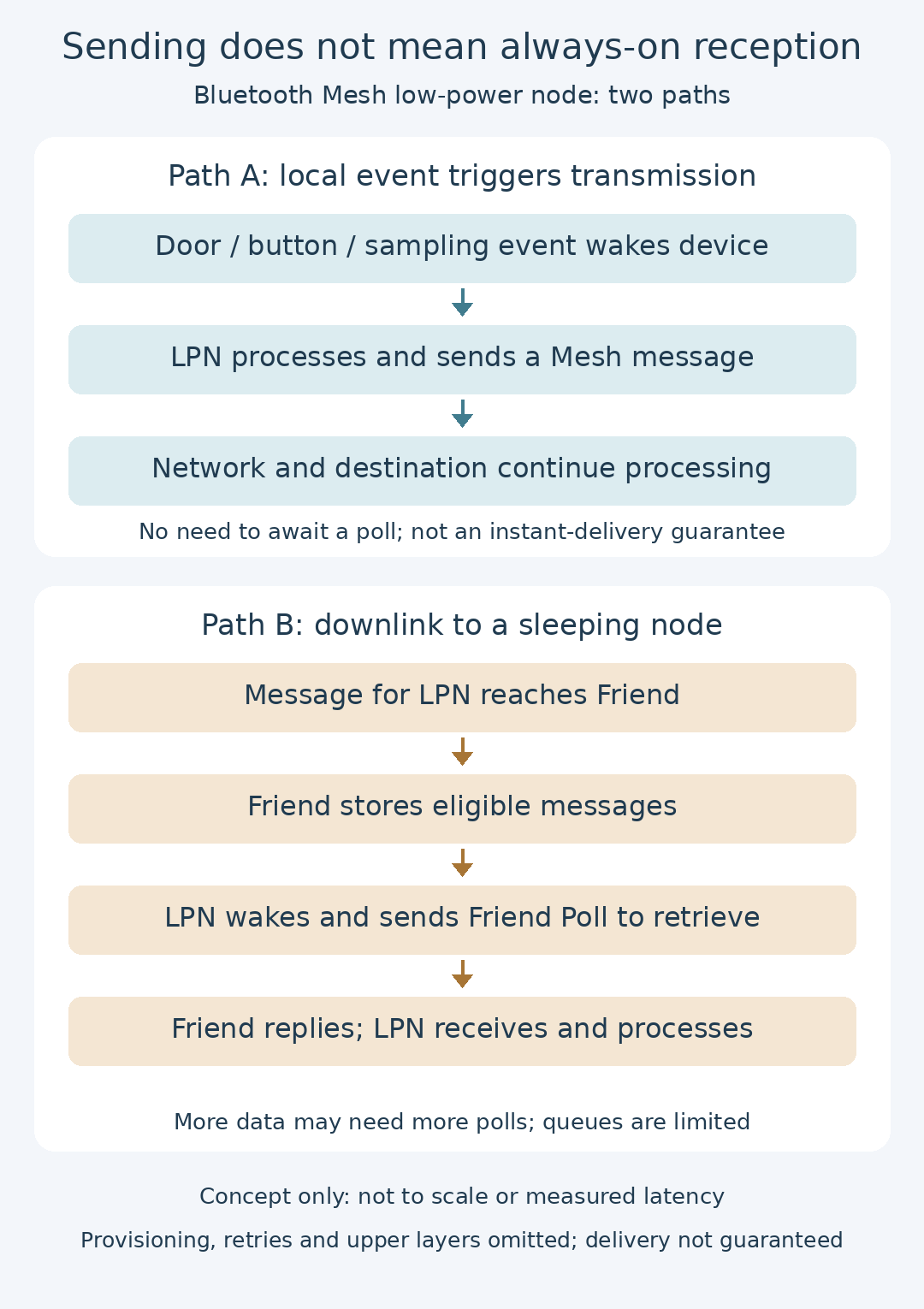
Think of someone who does not constantly watch a mailbox. They can go out to deliver a letter when necessary; incoming letters can be held by a neighbor until collected.
That neighbor is the Friend; the device using the Low Power feature is a Low Power Node, or LPN. This analogy explains reception scheduling, not guaranteed delivery or a Friend’s ability to wake a sleeping chip remotely.
Check first: draw separate paths for event reporting and remote configuration. The phone side may include a gateway, cloud and caches; do not assign every delay to Mesh radio communication.
2. Why can a button transmit while a settings change waits?
Silicon Labs documents that an LPN can transmit without waiting for the next message poll. Whether a button or door event wakes it promptly depends on hardware and application design.
- Local event: event → wake and process → transmit → destination processing.
- Downlink: message reaches Friend → waits for retrieval → LPN receives and processes → reports the result if needed.
Not waiting for a poll does not guarantee fast end-to-end delivery. Sampling, retries and upper-layer processing still matter. Slow downlink likewise does not prove every outbound event is slow. A prompt door-open report cannot justify an immediate-configuration promise.
Check first: record the event, transmission, Friend queueing, LPN retrieval and actual application of the setting. Do not subtract timestamps from unsynchronized devices.
3. Why does saving power require more than fewer transmissions?
A sensor that rarely reports may still consume substantial energy if its receiver stays on.
Bluetooth SIG describes Low Power primarily in terms of reduced receiver duty cycle. After establishing friendship, an LPN can reduce continuous listening, letting its Friend store eligible messages for later retrieval.
The Friend is not an unlimited mailbox. Supported LPNs, buffered messages and subscriptions depend on implementation and resources. Backlogs, retries and repeated friendship establishment can increase consumption.
Check first: identify what the current trace represents—sampling, scanning, transmitting, retrieving messages or searching for a Friend. A datasheet’s minimum sleep current is not the whole product’s consumption.
4. Does increasing PollTimeout save more power?
Not necessarily. Separate how often the device collects messages from how long a friendship may remain without qualifying contact.
The actual polling interval depends on stack and application scheduling. Additional queued messages may cause further polls.
PollTimeout is a friendship maintenance timeout. A Friend may end the relationship when the required requests do not arrive in time. It is not an application wake-up timer or a measured downlink latency.
ReceiveDelay concerns the wait between an LPN request and the start of listening; ReceiveWindow concerns the reception window. Neither is automatically a business-operation period.
Less frequent retrieval usually makes some downlink messages wait longer. Queueing, retries and execution also matter, so a single parameter cannot guarantee a maximum delivery time.
Check first: compare application polling policy, maintenance parameters and observed timing, rather than treating a timeout field as the only control.
5. Why might switching a light off make a sensor consume more?
Suppose a light supporting Friend serves a battery node, but a mechanical switch removes its power. The old receive relationship can no longer work normally.
Silicon Labs notes that restarting either Friend or LPN requires re-establishment. Marginal signals that repeatedly break friendship also increase energy use. Searching in a tight loop is not a power-saving strategy; design backoff and recovery for your implementation.
Location matters too. Bluetooth SIG’s introductory article says Friend Request is not relayed. Multihop application traffic does not mean an LPN can discover a Friend an arbitrary number of hops away.
Friend, Relay and application gateway are different roles. Relaying does not imply message storage for LPNs, and a product called a gateway need not expose Friend support. Do not assume a battery node should continuously relay for others.
Check first: verify candidate features, direct reachability and power habits, then test outages. Do not assume old queues migrate or Friend changes are seamless.
6. Measure average product current before predicting battery life
The whole product stands between a low-power mode and a lifetime claim. Sensors, regulators, LEDs, debuggers and logging can all affect consumption. Include sampling, user actions, reporting, retrieval, retries and discovery in the workload.
Average current ≈ sum of each state’s current × duration ÷ total observation time.
Using a consistent battery-side basis, usable capacity (mAh) ÷ average current (mA) ≈ operating hours. With voltage conversion, account for efficiency or use consistent energy units; do not mix parameters from opposite sides of a converter.
This is still not a guarantee. Temperature, aging, self-discharge, pulse capability and cutoff voltage affect usable capacity.
Check first: measure steady operation and fault recovery separately. A brief idle trace after provisioning under good reception does not represent an entire use cycle. At low charge, examine voltage dips and communication failures too.
7. Keep this checklist for prototype testing
These are engineering checks, not certification tests. Use an isolated environment and agree workload, acceptable waiting and success criteria before measuring.
| Symptom | Check first | Do not jump to this conclusion |
|---|---|---|
| Reporting works, but setting changes wait | Both paths, polling, queueing and application time | Radio reception must be poor |
| Sleep current is low, but the product drains its battery | Sampling, listening, sending, retries and peripherals | A new battery or chip will solve it |
| Behavior changes after Friend power loss | Lost friendship, backoff, re-establishment and recovery | Queues migrate and switching is seamless |
| Rapid setting changes produce unexpected results | Queue limits, application handling and final state | Every historical command is retained forever |
| Some group messages are missed | Model and Friend subscription lists, traffic | Multicast guarantees success for every node |
| Intermittent failures at low charge | Voltage during transmission, supply capability, recovery | All nominal capacity is usable |
Record board, SDK, parameters, layout and observation window. Pseudonymize device identities; do not publish NetKey, AppKey, DevKey or device private keys.
For selection, start with three questions:
- Mostly occasional outbound events? Evaluate LPN and Friend, but measure the real workload.
- Timely inbound commands required? Agree acceptable waiting, then validate reception policy against battery budget.
- Long standby, immediate reception and continuous relaying all required? Check that the objectives are compatible before promising battery life.
The useful question is not simply whether Bluetooth Mesh supports batteries. It is: when does the device wake, what does it do, and what happens when messages cannot currently be received? Answer these before estimating lifetime.
Further reading: Bluetooth Mesh selection and acceptance checklist.
Sources and scope
- Bluetooth SIG: Bluetooth Mesh Networking: Friendship, August 24, 2017. Historical introductory material for basic mechanisms, not a replacement for your current specification version.
- Silicon Labs: Bluetooth Mesh Node Power Consumption, 11.0.1. Outbound transmission, receive windows, friendship recovery and consumption guidance; use your actual SDK.
Sources checked November 6, 2026. This is document analysis and engineering guidance, not a first-hand test report or a verified guarantee of lifetime, latency or capacity.
Discussion
Share a question or your experience. Comments appear after moderation. Your email is never displayed publicly. Comment privacy
Loading comments…